





The Comedians
Biography, Drama, History


"The Most Exquisitely Crafted Film Biography Made During The Third Reich!"
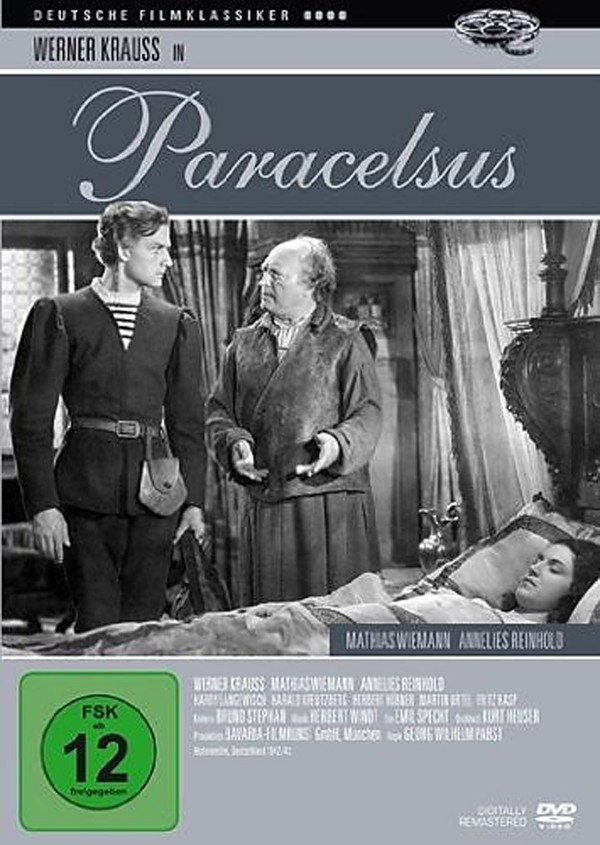
Our enemy is death. Sixteenth-century, Swiss-born, philosopher-healer Paracelsus (Werner Krauss) upsets Basel's medical and political establishment with homeopathic methods of treating illness. Paracelsus is a sumptuously produced, tumultuous costume biography produced by Bavaria-Filmkunst in Prague. It is one of the most robust epics in Third Reich cinema, featuring spectacular sets and costumes and impressive performances from some of the great names of '20s and '30s German film. Paracelsus' chief adversary, Basel's town doctor, is played by veteran character actor Fritz Rasp (Metropolis), who, in one of the finest character parts of the Nazi era, virtually steals the picture from its star, Werner Krauss (The Cabinet of Dr. Caligari, Tartuffe, The Student of Prague). The film's most celebrated setpiece is an astonishingly macabre, Expressionist dance that symbolizes the entry of the Black Death into quarantined Basel. This brilliantly choreographed Totentanz (Dance of Death), performed by the juggler Fliegenbein (Harald Kreutzberg), has been observed, in one of cinema's great shock moments, by the figure of Death. Paracelsus, combatting obscurantists in medicine, is presented as a Faustlike healer with a National Socialist worldview. Abandoned by all, as Frederick the Great and Adolf Hitler would be, Paracelsus perseveres, a heroic figure to whom all must turn whenever there is misery and suffering. There are those who claim that director G. W. Pabst's talkies are inferior to his silent work. But although The Love of Jeanne Ney, Pandora's Box, and Diary of a Lost Girl remain his best efforts, the talkies Westfront 1918, Die 3 Groschenoper, and Kameradschaft are better than most other directors' best work. Paracelsus is very nearly one of these and is long overdue for reappraisal.
This movie was featured in a documentary “HITLER’S HOLLYWOOD”. It was implied that “Paracelsus” had anti-Nazi sentiment as approved by Goebbels. The hypothesis offered was that Goebbels had permitted its release as a sop to the intelligentsia. I think this hypothesis, asserted as a fact in HITLER’S HOLLYWOOD, is false. I think it is quite the opposite. It’s about a heroic figure (like Adolf Hitler) who confronts the establishment.
Werner Krauss is Paracelsus, a man whose enemy is death. He meets his foe on the battlefield of the human body in sickness. His foe is assisted by the forces of the Establishment: the rich, seeking ever more riches through monopolies on the latest panacea, the medical colleges, who think that all knowledge of health is contained in Galen and Avicenna. He struggles, and has his victories, and failures, only to rise again, fighting plague, stupidity, cupidity, and vanity, all in the context of 16th Century Germany. It is an anti-elite movie. Paracelsus emphasizes the main political and social message of national socialism: class division is bad for a successful and harmonized society.
Paracelsus was called “a remarkably interesting film” by The New York Times’s Vincent Canby (when it received its belated U.S. premiere in 1974).
Also, I would like to draw the viewer’s attention to the audio commentary by a charlatan, and Marxist propagandist named Samm Deighan, who presents herself as “a writer and film critic”. It gives you an understanding why the cultural level among the American public is so low because the narrative is controlled by “experts” like her. This “writer” claims that Pabst was somehow “basically is kind of captured and forced” to make Paracelsus” by Goebbels. That is totally false. You can find multiple publications on internet proving that he did it of his own free will and his film career in the USA did not get any traction prior to 1939.
Samm Deighan continues her fake narrative saying that “the majority, honestly, of German and Austrian and Hungarian directors from the period pretty much all followed the same pattern” (meaning left Germany-adm.). Then she employs one of the favorite cultural fraudsters tricks, as she quotes another charlatan Eric Rentschler, who she presents “as one of the sort of major German cinema critics”. The “writer and film critic” quotes Eric Rentschler: “the National Socialists purged a once-internationally recognized industry of its artistic vanguard and the greater portion of its professional craft and technical expertise. Thousands of filmmakers, among whom were Jews, progressives, and independents, would flee Germany, replaced in many instances by politically correct hacks and second-rate opportunists.” I guess that Helmut Kautner, Wolfgang Liebeneiner, Veit Harlan, Hans Steinhoff, Bruno Mondi and many more were second-rate opportunists. At the same time, she is praising the excellent production values of Paracelsus. Just wondering how “second-rate opportunists” were able to make this film? Here is another statement: “because something like 90 % of the country’s most talented filmmakers or I want to say the region’s most talented filmmakers, because I think we have to include Austria, Hungary, Switzerland, the majority of Central Europe, are gone.” Where did that number come from? Who performed the calculation and what was the criteria?
Then the Marxist propagandist follows up with “…and yes you could certainly make a case that not a lot of great films came out of Germany and Austria in the 40s. fantasy film I love things like Munchausen they’re not necessarily making these great cinematic masterpieces that people still talk about regularly today.” The logic is: if people don’t talk about these films, then “not a lot of great films came out of Germany and Austria in the 40s.” The viewer can judge whether this statement is true or not. Also, very indicative about her cultural sophistication is the fact that she highlights a fantasy film like Munchausen as a great film while ignoring outstanding dramas and biopics.
Samm Deighan’s other claim is “the number one goal of really any kind of Nazi media is propaganda. They also really tried to manipulate people’s feelings.” I personally think this applies to Hollywood, first and foremost. In my opinion, making a high-quality cultural product that elevates people’s cultural and spiritual level is not manipulating people’s feelings.
And of course she would not leave an opportunity to contemporize the film. “I think there are some very alarming parallels here with the current trend in right -wing America, where quote -unquote science is viewed as a series of ideas you can choose to believe in or not, rather than as being observable, measurable facts and rules about the way the universe exists.” How could all these illiterate MAGA people question such an authority in science like Dr. Fauci or man-made global warming hoax.

Not a bad movie, very interesting. But I do have a problem with the “propaganda ” by the Administration comments. It seems that they drank the kool-aid of the communist democrats in the U.S .
Good!
Response from Third Reich Movies
Thanks!